
When Your Body Stops Trying - And Why That's Not What You Think

What your nervous system is really telling you: understanding dorsal vagal shutdown.
There's a kind of exhaustion that sleep doesn't touch.
A heaviness that has nothing to do with laziness.
A numbness that isn't indifference.
A fog that doesn't lift, no matter how long you rest or how hard you try.
Messages you mean to reply to, sitting unanswered for days. Plans you genuinely wanted to make, quietly let go. Conversations that feel like they're happening at a slight distance, as though you're present but not quite there.
The things that used to matter: work, relationships, hobbies, even the small daily pleasures feel strangely out of reach. The desire is somewhere underneath it all. You just can't seem to access it.
You sleep, sometimes more than you ever have, yet wake up just as exhausted as when you closed your eyes. Rest doesn't restore you. Sleep doesn't refresh you. No matter how many hours you take, the tiredness is still there waiting when you open your eyes.
Your body feels heavy. Getting up feels like effort. Doing the simplest things takes more than you seem to have.
You're not anxious in the way people recognise. You're not panicking or falling apart. You're just... absent. Watching your life from somewhere slightly behind yourself, wondering when you'll feel like a person again.
If any part of that resonates, you're not broken. You're not alone.
What you may be experiencing has a name. It's called dorsal vagal shutdown. Once you understand what it actually is, it changes everything.
Your Nervous System Has One Job
Before we talk about shutdown, it helps to understand what your nervous system is actually doing every moment of every day.
It isn't trying to make you happy. It isn't trying to make you productive. It isn't interested in your goals or your to-do list.
It has one job: keep you alive.
That's it. Everything else is secondary.
When life feels safe and manageable, your nervous system lets you engage - with people, with work, with meaning, pleasure, and connection. This is your natural state. The one you were built for.
When life feels threatening, it mobilises. Heart rate up. Muscles primed. The classic fight-or-flight response most people are familiar with.
There's a third response, though. One that doesn't get talked about nearly enough.
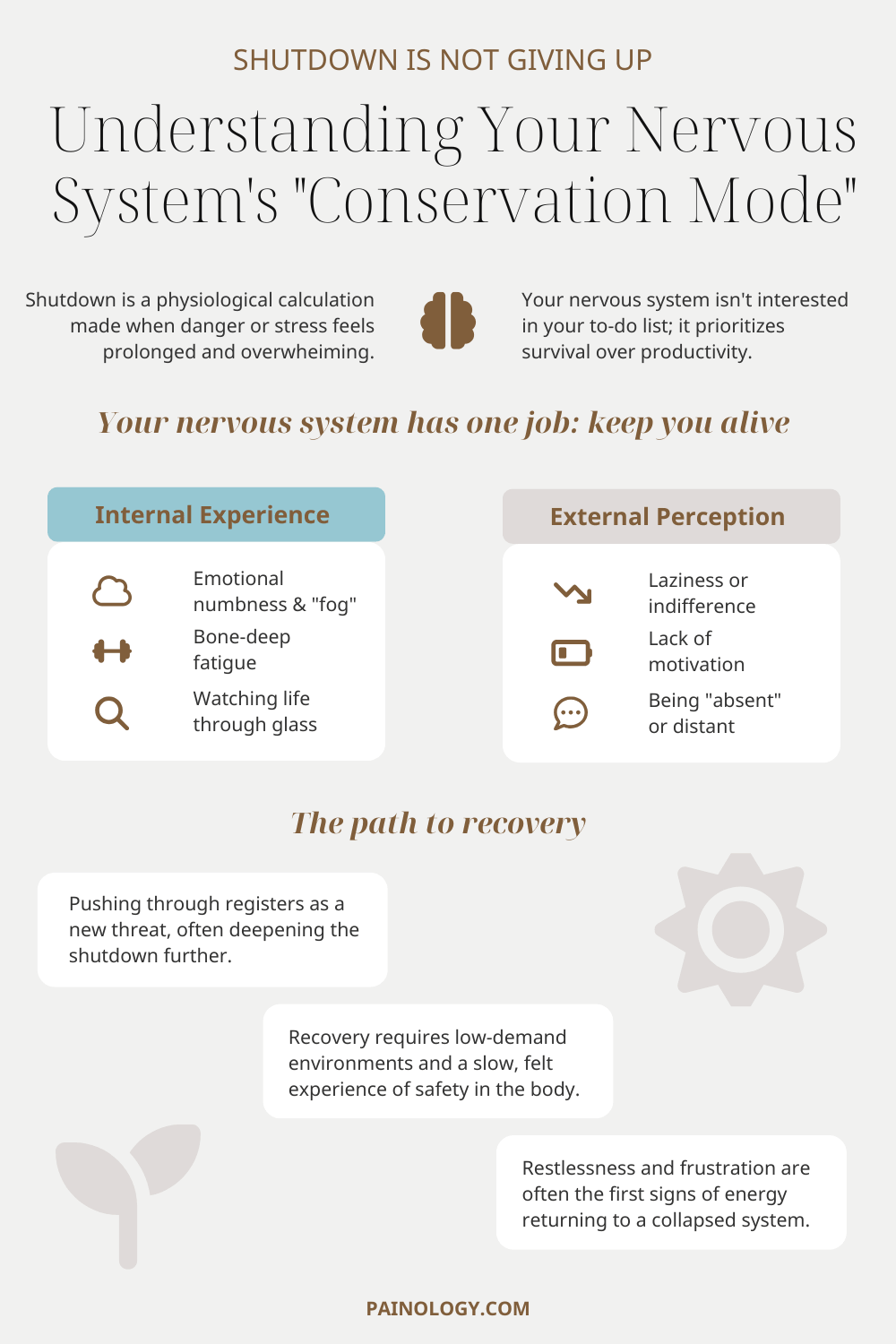
When the threat feels inescapable - when danger has been prolonged, repeated, or overwhelming - your nervous system makes a different calculation altogether.
If I can't escape this, I will conserve.
That decision is dorsal vagal shutdown. [6]
What counts as a "threat"
This is where it gets important - the nervous system doesn't distinguish between dramatic, obvious danger and the quieter, more everyday kind.
A threat, in your body's terms, is anything it has learned to associate with pain, loss of control, or the absence of safety. That might look like:
Years of living with pain that nobody around you seems to understand
A job, relationship, or home environment where you've been walking on eggshells
Repeated experiences of asking for help and not receiving it
Growing up in a household where emotions weren't welcome
Carrying responsibility for others with very little support yourself
A body that keeps letting you down, no matter how hard you try to manage it
Feeling dismissed, minimised, or disbelieved- by others, or by the medical system
Doing everything right and still not getting better
None of these have to be dramatic. The accumulation is what matters. The nervous system keeps a running account of how safe the world feels - and when that account has been in deficit for long enough, it begins to act accordingly. [5]

What It Feels Like From the Inside
People describe dorsal vagal shutdown in ways that are remarkably consistent - even when they've never heard the term before.
"I know I should care about this. I just can't feel anything."
"I want to move forward. I just can't access the energy."
"I feel like I'm watching my life through glass."
"It feels safer to withdraw than to try."
The symptom picture often includes emotional flatness or numbness, a bone-deep fatigue that doesn't shift with rest, brain fog and difficulty concentrating, a loss of motivation or desire, withdrawal from people and conversations, and difficulty feeling pleasure or joy. [3]
Underneath all of that, for many people, there's something else.
Shame.
From the outside - and often from the inside too - it can look like giving up. Like not trying hard enough. Like weakness or negativity or laziness.
So you start to believe those stories about yourself.
Here's what I want you to hear: shutdown is not giving up. Shutdown is your system holding on.
How Your Body Gets Here
This state rarely arrives from one single event. It builds.
It's what happens after years of living in survival mode with no real recovery. After chronic pain or illness that never fully relents. After emotional neglect, or circumstances where asking for help didn't feel safe. After being the strong one for so long you forgot you were allowed to need support too.
Your nervous system is always learning. What it learns, when activation is repeatedly met with pain or disappointment or helplessness, is this:
Trying costs more than I have. Better to stop.
So it slows everything down. It conserves. It pulls inward. What felt like a temporary response gradually becomes the baseline. [8]
This is why so many people with chronic pain, long-term illness, or persistent emotional overwhelm find themselves in this place. Not because something is fundamentally wrong with them. Their body has been carrying too much, for too long, without enough safety or support to process it.
Why Pushing Through Makes It Worse
Here's where the conventional advice gets it badly wrong.
When people recognise something isn't right - when they see themselves withdrawing, struggling to function, feeling flat or numb - the instinct (and often the instruction from well-meaning people) is to push. Try harder. Think more positively. Just get on with it.
You cannot think your way out of a physiological state.
When your nervous system is in shutdown, the parts of your brain responsible for reasoning, planning, and positive reframing are the first to go offline. [1] The very tools you're being told to use are the ones least available to you.
Forcing activation on a system in conservation mode registers as another threat. You push. The body responds by shutting down further. The fog gets thicker. The fatigue deepens. You end up more convinced than ever that something is fundamentally wrong with you.
Nothing is wrong with you. The approach is wrong.
What Your Nervous System Is Actually Asking For
When you're in dorsal vagal shutdown, your nervous system isn't asking:
What should I do next? What do I want? How do I get motivated?
It's asking something far more fundamental:
Is it safe to be here? Is it safe to feel? Is it safe to hope again?
Until the answer to those questions shifts - in the body, not just in the mind - energy won't return. Connection won't return. The capacity to engage with life won't return.
“Safety is the treatment.”
– STEPHEN PORGES
This is why healing from shutdown doesn't start with goals or plans or productivity. It starts with safety. Not the idea of safety. The felt experience of it, in your body. [2]
That means slow and predictable. Low demand. Gentle reconnection with sensation. Rebuilding trust - with your body, and with your experience.
It means working with your nervous system, not against it.
Free Resources on Painology - Including a Meditation Designed for This
If you've read this far and recognised yourself, there's no need to do anything big with that recognition.
Painology has a range of free resources to help you begin gently - no commitment, no pressure, and no requirement to understand everything first. You can find them at painology.com/start-here.
One of those resources is worth mentioning specifically.
There is a short, free meditation - Gentle Pause - that was created specifically for people experiencing dorsal vagal shutdown. It's designed for moments when thinking feels effortful, when your body feels tense or shut down, or when you simply need somewhere to pause without being asked to do more.
You don't need to feel calm before you begin. You don't need to concentrate perfectly. You don't need to do it right.
You can access it directly here: painology.com/begin-gently
It's just under nine minutes. It asks nothing of you. That's deliberate.
The Signs You're Beginning to Come Back
This surprises people, so it's worth preparing for.
The first signs of coming out of shutdown are often not what we hope for.
They're not joy. They're not suddenly feeling motivated or connected. They're frequently things like irritation. Restlessness. A frustration that wasn't there before. Sadness rising to the surface. Tears without a clear reason. An impatience with how things are.
That is not regression. That is energy returning to your system.
It means your nervous system is beginning to shift from deep collapse toward re-engagement - and that transition, however uncomfortable, is a sign that things are moving. [4]
The key is not to panic when it feels harder before it feels easier. Pushing too fast can tip you back into shutdown. The pace needs to be gentle. Consistent. Sustainable.
If You're Supporting Someone in Shutdown
Perhaps you're not reading this for yourself.
Perhaps you recognise someone you love in these words - a partner, a parent, a friend, a child - and you're trying to understand why they've gone so quiet. Why they've withdrawn. Why they seem unreachable, even when you're right there.
Living alongside someone in dorsal vagal shutdown can be its own kind of exhausting. You might feel shut out, helpless, or frustrated. You might have tried everything you can think of to help, and watched none of it land.
A few things that may be worth knowing:
Their withdrawal is not a rejection of you. The nervous system in shutdown pulls away from everything - not from you specifically. It's a survival response, not a relational one. As hard as it is to witness, the withdrawal is the body trying to protect itself, not distance itself from the people it loves.
Pressure, however well-intentioned, tends to deepen shutdown. Encouragement, urgency, suggestions to "just try this one thing" - all of these register as demand. Demand registers as threat. What helps more is consistency, patience, and a low-pressure presence. Showing up without agenda. Being predictable. Reducing the need for performance.
You cannot regulate their nervous system for them - but your regulated presence does matter. Research on co-regulation shows that when one person's nervous system is calm and settled, it genuinely influences the people around them. [7] You don't fix it. You don't force it. You offer safety by embodying it yourself.
Your own wellbeing matters too. Supporting someone in chronic shutdown is a long road. Seeking your own support - whether through therapy, community, or simply being honest about how hard it is - isn't a betrayal of them. It's what makes sustained support possible.
If someone you care about is living with chronic pain, long-term illness, or persistent overwhelm, Painology's resources may be helpful for them - or simply for you, in understanding what they're going through. painology.com/start-here is a good place to begin.
Where to Begin
If this resonates, start smaller than you think you need to.
Not with a plan. Not with pressure. Not with trying to fix yourself.
Start with listening.
Your nervous system isn't asking you to become more. It's asking to feel safe enough to be here again.
That journey - from shutdown to presence, from surviving to living - is exactly what Painology is here to support.
You don't need a diagnosis to begin. You don't need to have the answers. You just need a starting point.
Please note: this article is for informational purposes and is not a substitute for professional medical or psychological support. If you are experiencing persistent symptoms, speaking with your GP or a qualified practitioner is always a worthwhile step.
References
Arnsten, A. F. T. (2009). Stress signalling pathways that impair prefrontal cortex structure and function. Nature Reviews Neuroscience, 10(6), 410–422. https://doi.org/10.1038/nrn2648
Dana, D. (2018). The polyvagal theory in therapy: Engaging the rhythm of regulation. W. W. Norton & Company.
Ford, J. D., & Courtois, C. A. (2009). Defining and understanding complex trauma and complex traumatic stress disorders. In C. A. Courtois & J. D. Ford (Eds.), Treating complex traumatic stress disorders (pp. 13–30). Guilford Press.
Levine, P. A. (2010). In an unspoken voice: How the body releases trauma and restores goodness. North Atlantic Books.
McEwen, B. S. (2008). Central effects of stress hormones in health and disease: Understanding the protective and damaging effects of stress and stress mediators. European Journal of Pharmacology, 583(2–3), 174–185. https://doi.org/10.1016/j.ejphar.2007.11.071
Porges, S. W. (2011). The polyvagal theory: Neurophysiological foundations of emotions, attachment, communication, and self-regulation. W. W. Norton & Company.
Porges, S. W., & Dana, D. (Eds.). (2018). Clinical applications of the polyvagal theory: The emergence of polyvagal-informed therapies. W. W. Norton & Company.
Van der Kolk, B. A. (2014). The body keeps the score: Brain, mind, and body in the healing of trauma. Viking.